
Active Ingredients

Zinc Oxide: Reliable Physical Protection, Backed by Testing

Your skin needs dependable defence against the visible ageing caused by daily UV exposure. Zinc Oxide sits on the skin's surface as a physical mineral barrier, reflecting and scattering broad-spectrum UV radiation before it can reach your cells.

Benefits

Reflects and scatters broad-spectrum UV radiation Helps protect against sunburn and photoageing Tested to a mean SPF of 26.2 in independent trials Confirmed gentle enough for sensitive skin, including newborns Supports emulsion stability within formulations Suitable as a gentler alternative to chemical UV filters

Best For

All skin types Sensitive skin Mature or ageing skin Sun protection Newborn-safe formulations Daily UV defence
What Is Zinc Oxide?

The skin is our outer barrier, but it needs external defence against environmental stressors. Sun damage and photoageing are primarily triggered by UV radiation penetrating vulnerable skin layers. Unlike an antioxidant, which works inside the cell, Zinc Oxide functions as a physical, mineral filter, sitting on top of the skin's surface and deflecting UV rays away from the body before they interact with skin cells.

Zinc oxide is an inorganic, mineral compound long recognised for its versatility across pharmaceutical, cosmetic and industrial products. It can be synthesised as micron-sized particles or nanoparticles, and is recognised as GRASE (Generally Recognized as Safe and Effective) by the FDA, and approved by the European Commission for use as a UV filter.

In formulations, ZnO appears as an uncoated or surface-modified powder, chosen for its role as a colorant, bulking agent, UV filter or emulsion stabiliser.

How It Works

Zinc oxide protects the skin through physical, rather than chemical, mechanisms. As a semiconductor with a wide band gap and strong exciton binding energy, it reflects and scatters incoming UV radiation instead of absorbing it, unlike organic filters.

Inorganic filters such as ZnO remain on the skin's surface rather than absorbing in. Multiple studies have confirmed ZnO nanoparticles do not penetrate the deeper layers of healthy adult skin (Sogne et al., 2017; Lu et al., 2015).

Particle shape and size, whether needle-shaped, planar or nanosized, significantly influence UV-blocking efficacy. Under UV exposure, ZnO's photocatalytic activity can generate reactive oxygen species, so modern formulations mitigate this by doping ZnO with elements such as aluminium, iron, copper, manganese or sodium, or by applying protective surface coatings, reducing ROS generation while preserving SPF performance.

Why Formulation Matters

Translating zinc oxide into an effective, pleasant-to-use product is a formulation challenge in its own right. An even, well-dispersed particle distribution is critical, since poor homogenisation leaves the finished product with unbalanced sun-protection performance.

A common approach separately heats an oil phase and an aqueous phase, then blends them under constant stirring, dispersing ZnO particles into whichever phase suits their surface coating. Stability depends on pH, ionic strength, chemical composition and the surfactants present.

Poorly formulated ZnO sunscreens can leave a visible white cast. Controlling particle size and surface coating during synthesis helps deliver reliable protection while keeping the product cosmetically elegant, and nanoparticle forms also face stringent safety evaluation from regulators.

Scientific Notes

Zinc oxide acts as a physical mirror, bouncing UV rays away from the skin rather than absorbing them and converting them to heat, which is how chemical filters work. Because it is chemically inert, it is also widely used in soothing skin protectant products across pharmaceutical and cosmetic formulations.

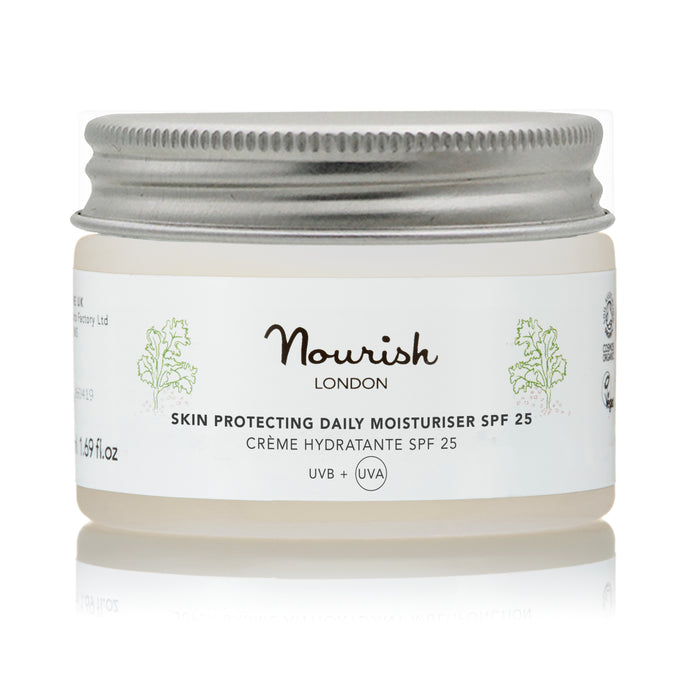
As Dr Pauline Hili, Nourish London's founder and formulator, explains: "We use a non-nano zinc oxide in our COSMOS-approved SPF 25. It took a long time to get the formula right, balancing protection with wearability. In independent testing, our finished formula achieved a mean SPF of 26.2, and a 30-person skin safety panel confirmed it's gentle enough to be suitable even for newborns."

Products With Zinc Oxide